Author Archives: %s

Pro Online: Prior Year Returns not rendering a calculation [RESOLVED]

18 Jan 21
Kim Manuel
No Comments

9:00am ET: Prior year calculation issues have been resolved.


We are currently working to resolve an issue for all prior year returns that are not rendering a calculation.  If you have opened a prior year return and the calculations are spinning, click on Basic Information and then Close and Exit Return.  We will update this post when this has been resolved.

Pro Online 2020: Prints [RESOLVED]

18 Jan 21
Kim Manuel
No Comments

9:00am ET: Print issue has been resolved.


Printing is not currently working in TY2020.  We are completing the roll out of turning on Start New Return at the production sites.  As we progress through this process, we will update the post for printing.

1040NR Status of electronically filing

18 Jan 21
Kim Manuel
No Comments

The IRS will not begin taking in test returns from software vendors until March (current schedule).  During the interim, the taxpayers will need to mail in their 1040NR returns or hold them until e-file opens (most likely late March).


FSA Kiosk URLs

18 Jan 21
Kim Manuel
No Comments

We will begin distributing the approved TY 2020 FSA URLs starting today, Monday, January 18th.

What the sites CAN do:

Email the site-specific FSA link to the taxpayer with information on how they can contact them (the VITA/TCE site) if they have any questions during the process of preparing their return.  This also allows the site to do the following if they can do so:

  • Screenshare with the taxpayer and assist them as the taxpayer prepares the return
  • Talk them through the screens via telephone (since the site can create up to five accounts per email address) to walk their taxpayers through the return
  • Create a quick PPT or word doc to send with the link to provide instructions for the taxpayer

Place the site-specific link behind a secured login (similar to an employee intranet site)

What the sites CANNOT do:

  • Email to a random listing of taxpayers (needs to be targeted to specific taxpayers)
  • Place the link on a public facing website

Click here to download the FSA User Guide, Best Practices Guide and Chrome troubleshooting tips.

Remember:  You must always start from the URL you received from TaxSlayer.


IRS Newswire: 2021 tax filing season begins Feb. 12; IRS outlines steps to speed refunds during pandemic

15 Jan 21
Kim Manuel
No Comments

WASHINGTON ? The Internal Revenue Service announced that the nation’s tax season will start on Friday, Feb. 12, 2021, when the tax agency will begin accepting and processing 2020 tax year returns.

The Feb. 12 start date for individual tax return filers allows the IRS time to do additional programming and testing of IRS systems following the Dec. 27 tax law changes that provided a second round of Economic Impact Payments and other benefits.

This programming work is critical to ensuring IRS systems run smoothly. If filing season were opened without the correct programming in place, then there could be a delay in issuing refunds to taxpayers. These changes ensure that eligible people will receive any remaining stimulus money as a Recovery Rebate Credit when they file their 2020 tax return.

To speed refunds during the pandemic, the IRS urges taxpayers to file electronically with direct deposit as soon as they have the information they need. People can begin filing their tax returns immediately with tax software companies, including IRS Free File partners. These groups are starting to accept tax returns now, and the returns will be transmitted to the IRS starting Feb. 12.

“Planning for the nation’s filing season process is a massive undertaking, and IRS teams have been working non-stop to prepare for this as well as delivering Economic Impact Payments in record time,” said IRS Commissioner Chuck Rettig. “Given the pandemic, this is one of the nation’s most important filing seasons ever. This start date will ensure that people get their needed tax refunds quickly while also making sure they receive any remaining stimulus payments they are eligible for as quickly as possible.”

Last year’s average tax refund was more than $2,500. More than 150 million tax returns are expected to be filed this year, with the vast majority before the Thursday, April 15 deadline.

Under the PATH Act, the IRS cannot issue a refund involving the Earned Income Tax Credit (EITC) or Additional Child Tax Credit (ACTC) before mid-February. The law provides this additional time to help the IRS stop fraudulent refunds and claims from being issued, including to identity thieves.

The IRS anticipates a first week of March refund for many EITC and ACTC taxpayers if they file electronically with direct deposit and there are no issues with their tax returns. This would be the same experience for taxpayers if the filing season opened in late January. Taxpayers will need to check Where’s My Refund for their personalized refund date.

Overall, the IRS anticipates nine out of 10 taxpayers will receive their refund within 21 days of when they file electronically with direct deposit if there are no issues with their tax return. The IRS urges taxpayers and tax professionals to file electronically. To avoid delays in processing, people should avoid filing paper returns wherever possible.

Tips for taxpayers to make filing easier

To speed refunds and help with their tax filing, the IRS urges people to follow these simple steps:

  • File electronically and use direct deposit for the quickest refunds.
  • Check IRS.gov for the latest tax information, including the latest on Economic Impact Payments. There is no need to call.
  • For those who may be eligible for stimulus payments, they should carefully review the guidelines for the Recovery Rebate Credit. Most people received Economic Impact Payments automatically, and anyone who received the maximum amount does not need to include any information about their payments when they file. However, those who didn’t receive a payment or only received a partial payment may be eligible to claim the Recovery Rebate Credit when they file their 2020 tax return.  Tax preparation software, including IRS Free File, will help taxpayers figure the amount.
  • Remember, advance stimulus payments received separately are not taxable, and they do not reduce the taxpayer’s refund when they file in 2021.

Key filing season dates

There are several important dates taxpayers should keep in mind for this year’s filing season:

  • Jan. 15. IRS Free File opens. Taxpayers can begin filing returns through Free File partners; tax returns will be transmitted to the IRS starting Feb. 12. Tax software companies also are accepting tax filings in advance.
  • Jan. 29. Earned Income Tax Credit Awareness Day to raise awareness of valuable tax credits available to many people – including the option to use prior-year income to qualify.
  • Feb. 12. IRS begins 2021 tax season. Individual tax returns begin being accepted and processing begins.
  • Feb. 22. Projected date for the IRS.gov Where’s My Refund tool being updated for those claiming EITC and ACTC, also referred to as PATH Act returns.
  • First week of March. Tax refunds begin reaching those claiming EITC and ACTC (PATH Act returns) for those who file electronically with direct deposit and there are no issues with their tax returns.
  • April 15. Deadline for filing 2020 tax returns.
  • Oct. 15. Deadline to file for those requesting an extension on their 2020 tax returns

Filing season opening

The filing season open follows IRS work to update its programming and test its systems to factor in the second Economic Impact Payments and other tax law changes. These changes are complex and take time to help ensure proper processing of tax returns and refunds as well as coordination with tax software industry, resulting in the February 12 start date.

The IRS must ensure systems are prepared to properly process and check tax returns to verify the proper amount of EIP’s are credited on taxpayer accounts – and provide remaining funds to eligible taxpayers.

Although tax seasons frequently begin in late January, there have been five instances since 2007 when filing seasons did not start for some taxpayers until February due to tax law changes made just before the start of tax time.

IRS News Essentials: Treasury issues millions of second Economic Impact Payments by debit card

07 Jan 21
Kim Manuel
No Comments

WASHINGTON – Starting this week, the Treasury Department and the Internal Revenue Service are sending approximately 8 million second Economic Impact Payments (EIPs) by prepaid debit card.


These EIP Cards follow the millions of payments already made by direct deposit and the ongoing mailing of paper checks that are delivering the second round of Economic Impact Payments as rapidly as possible.


For those who don’t receive a direct deposit, they should watch their mail for either a paper check or a prepaid debit card. To speed delivery of the payments to reach as many people as soon as possible the Treasury’s Bureau of Fiscal Service is sending payments out by prepaid debit card.


IRS and Treasury urge eligible people who don’t receive a direct deposit to watch their mail carefully during this period. The prepaid debit card, called the Economic Impact Payment card, is sponsored by the Bureau of the Fiscal Service and is issued by Treasury’s financial agent, MetaBank®, N.A. The IRS does not determine who receives a prepaid debit card.


Taxpayers should note that the form of payment for the second mailed EIP may be different than the first mailed EIP. Some people who received a paper check last time might receive a prepaid debit card this time, and some people who received a prepaid debit card last time may receive a paper check.


More information about these cards is available at EIPcard.com.


EIP Cards are safe, convenient and secure. EIP Card recipients can make purchases online or in stores anywhere Visa® Debit Cards are accepted. They can get cash from domestic in-network ATMs, transfer funds to a personal bank account and obtain a replacement EIP Card if needed without incurring any fees. They can also check their card balance online, through a mobile app or by phone without incurring fees. The EIP Card provides consumer protections including certain protections against fraud, loss and other errors.


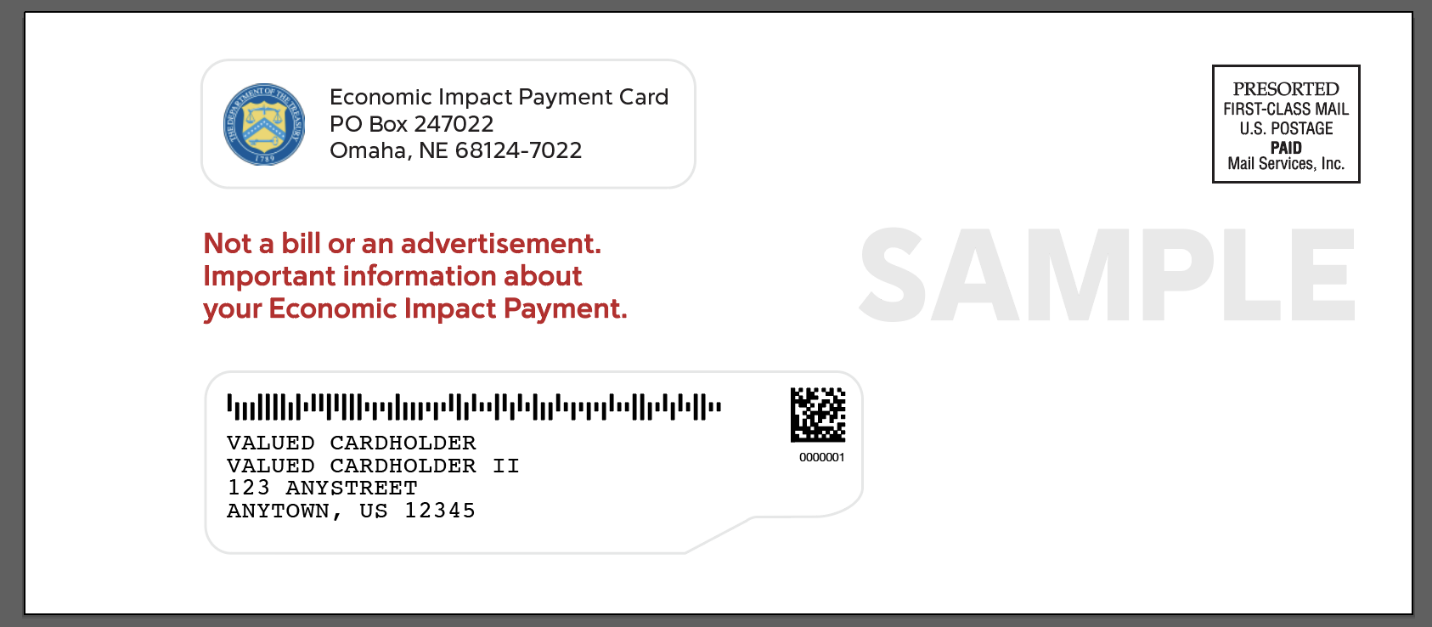
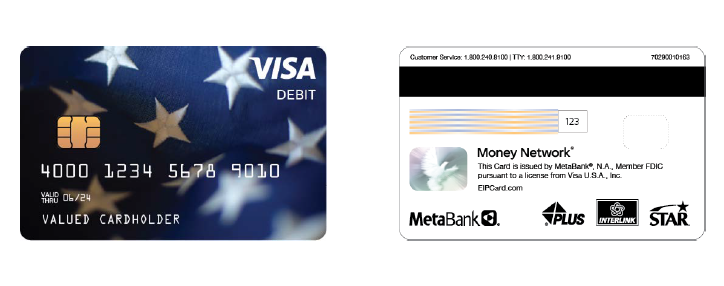
EIP Cards are being sent in a white envelope that prominently displays the U.S. Department of the Treasury seal. The EIP Card has the Visa name on the front of the Card and the issuing bank name, MetaBank®, N.A. on the back of the card. Each mailing will include instructions on how to securely activate and use the EIP Card.


EIP Debit Card Image


EIP Envelope Image


EIP Cards are being issued to eligible recipients across all 50 states and the District of Columbia. Residents of the western part of the United States are generally more likely to receive an EIP Card.


The swift issuance of this second round of payments follows the successful delivery of more than $270 billion in CARES Act Economic Impact Payments earlier this year. To check the status of a payment, visit IRS.gov/GetMyPayment. For more information about Economic Impact Payments visit IRS.gov/EIP.

QSRA 2021-01: Taxpayer and volunteer expired photo identification

06 Jan 21
Kim Manuel
No Comments

Purpose

Guidance for volunteers and approving officials regarding taxpayer and volunteer expired photo
identification.

Identified Issues
Some state governments have extended expiration dates on state photo identification for their
residents. Volunteer Income Tax Assistance (VITA) and Tax Counseling for the Elderly (TCE) sites
may accept expired state issued photo identification according to state guidance as valid for the
duration of the current filing season.

Message for Volunteers and Approving Officials

QSR 3: Confirming Photo Identification and Taxpayer Identification Numbers (TIN)
■ Coordinators must have a process in place to confirm taxpayers’ identities. This process must include
using acceptable documents to confirm taxpayers’ identities by reviewing photo identification for
primary and secondary taxpayers.
■ Volunteers reviewing original photo identification (ID) such as driver’s license (U.S.) and state ID may
accept expired identification according to state guidance on extended expiration dates.

QSR 5: Volunteer Agreement
■ Approving officials must validate volunteers’ identities using government-issued photo identification
(ID) when reviewing and signing Forms 13615. Volunteers’ identities must be verified prior to any
volunteers’ participation in the VITA/TCE programs. Government-issued photo ID includes valid
driver’s license (U.S.) and state ID.
■ Approving officials reviewing original photo identification (ID) such as driver’s license (U.S.) and state
ID may accept expired state identification according to state guidance on extended expiration dates.

Questions about this QSRA should be directed to your SPEC relationship manger.

IRS News Essentials: Issue Number: IR-2021-01

05 Jan 21
Kim Manuel
No Comments

Economic Impact Payments on their way, visit IRS.gov instead of calling

WASHINGTON – The Internal Revenue Service today urged people to visit IRS.gov for the most current information on the second round of Economic Impact Payments rather than calling the agency or their financial institutions or tax software providers. IRS phone assistors do not have additional information beyond what’s available on IRS.gov.

The IRS and the Treasury Department began issuing a second round of Economic Impact Payments, often referred to as stimulus payments, last week. 

The direct deposit payments may take several days to post to individual accounts. Some Americans may have seen the direct deposit payments as pending or as provisional payments in their accounts before the scheduled payment date of Jan. 4, 2021, which is the official date funds are available.

Paper checks also began going out and will continue to be sent through January. Some people will be mailed debit cards in January, and the IRS urges people to carefully check their mail. Mailed payments will require more processing and mailing time. Those who reside abroad will have longer wait times for checks as disruptions to air travel and mail delivery in some countries will slow delivery.

The IRS emphasizes that there is no action required by eligible individuals to receive this second payment. The payments are automatic, and people should not contact their financial institutions or the IRS with payment timing questions.

Eligibility
Generally, U.S. citizens and resident aliens who are not eligible to be claimed as a dependent on someone else’s income tax return are eligible for this second payment. Eligible individuals will automatically receive an Economic Impact Payment of up to $600 for individuals or $1,200 for married couples and up to $600 for each qualifying child. Most people who have an adjusted gross income for 2019 of up to $75,000 for individuals and up to $150,000 for married couples filing joint returns and surviving spouses, will receive the full amount of the second payment. For filers with income above those amounts, the payment amount is reduced.

Checking the status of a payment
Starting today, people can check the status of both their first and second payments by using the Get My Payment tool, available in English and Spanish only on IRS.gov.

Payment not received or less than expected? Claim on 2020 tax return
Payments started going out last week and will continue through mid-January. Direct deposit payments are being made first to those that have valid routing and account information on file for direct deposit purposes. Because of the speed at which IRS issued this second round of payments, some payments may have been sent to an account that may be closed or no longer active. By law, the financial institution must return the payment to the IRS, they cannot hold and issue the payment to an individual when the account is no longer active. While the IRS is exploring options to correct these payments, if you have not received your full payment by the time you file your 2020 tax return, you may claim the Recovery Rebate Credit on your tax return.

The credit is figured like the Economic Impact Payment, except that the credit eligibility and the credit amount are based on the 2020 tax year information, including income.

For people who received a partial Economic Impact Payment, they can take the Recovery Rebate Credit for any remaining amount they’re eligible for by completing line 30 of the 2020 Form 1040 or 1040-SR.

Changing bank account or mailing information
The IRS cannot change payment information, including bank account or mailing information. If an eligible taxpayer does not get a payment or it is less than expected, it may be claimed on the 2020 tax return as the Recovery Rebate Credit. Remember, Economic Impact Payments are an advance payment of what will be called the Recovery Rebate Credit on the 2020 Form 1040 or Form 1040-SR.

More information
For more information about Economic Impact Payments and the 2020 Recovery Rebate Credit, visit IRS.gov/eip. Starting next week, people can check the status of their payment at IRS.gov/GetMyPayment. For other COVID-19-related tax relief, visit IRS.gov/Coronavirus.