Tag: Volunteer Time

Volunteer Time: SPEC 4.0 Watch us grow: Rural West Virginia

31 Aug 18
Kim Manuel

No Comments

As SPEC continues its efforts to help more taxpayers in rural communities, the RM & partner success stories are building too. The goal is to share as many of these stories as possible, with the premise that they may possibly help others expand their reach in rural areas.
Here’s a rural success story from Tax Consultant Cassel Pulliam

Describe your geographic area and current partnership base.

I serve the state of West Virginia, which is one of the most rural and lowest per capita income states. The Eastern Panhandle of the state has two distinct cultures. One side of the mountains has been developed into suburban Washington, DC, and the other side remains sparsely populated with a mixed economy of agriculture, light industry (e.g. poultry processing and hardwood manufacturing), and tourism. The sparsely populated rural counties have been without VITA/TCE service for several years.

How did your success story begin?

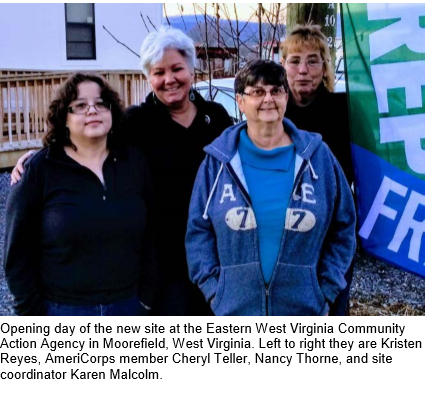
In the fall of 2017, AmeriCorps placed one member in each of our seven multi-county regional coalitions. Cheryl Teller, a volunteer who had many years of experience as a volunteer for both VITA and AARP, was placed in the Eastern Panhandle. Fortunately, Cheryl was on a mission to grow VITA in the Eastern Panhandle.

What steps did you take next?

Often, you either do the work or provide support to those who do the work. Sometimes you find yourself just trying to keep up. In this case, it was the latter. I met with Cheryl in the early fall to discuss the challenges we faced and determine where I could be the most help. My POD is in Charleston, which is a five-hour drive from much of the Eastern Panhandle. In Martinsburg, WV, you are closer to five state capitals than you are to Charleston. That makes for a different dynamic.

How long did it take you to work this opportunity?

Cheryl spent the next four months crossing the mountains, meeting with community leaders and potential volunteers. She recruited several partners, both traditional and FSA. Eastern West Virginia Community Action Agency, in rural Moorefield, WV, prepared returns at their office and occasionally at two VFWs and a public library. This coming filing season, they will be moving their office to a public library with more room. Cheryl also worked with her two sons and their friends to open, what I believe to be, the first high school VITA site in West Virginia.

In your opinion, what were the key actions that made this turn out successfully?

The key for this success story was the awesome collaboration between IRS and the partner. Working with Cheryl, an experienced, motivated volunteer, I was able to educate, strategize, suggest and support her efforts.  But the commitment and energy that Cheryl brought to the table made all the difference.  For her, VITA/TCE is truly more than a program or even a cause; it’s a calling.

What advice would you give to fellow TCs/RMs to gain additional successes?

Sometimes a good thing falls in front of you. When it does, you must recognize and nurture it. Develop a shared vision; provide support in every way possible; and step aside until needed.

Any other information you’d like to add:

Cheryl, her husband and family are returning to Alaska. Our new challenge is to maintain and build on the foundation she laid in the Eastern Panhandle.
Volunteer Time: Having partners with open minds can lead to success in rural areas

10 Aug 18
Kim Manuel

No Comments

Here’s a rural success story from Tax Consultant Gail Bonilla 

Describe to us your geographic area and current partnership base.

I cover the state of Hawaii, which includes Maui, Hawaii, and Kauai islands/counties that are rural. Goodwill Hawaii is located on all these island/rural areas and has VITA sites on each.

How did your success story begin?

Goodwill Hawaii is a valued VITA Grant partner. They have sites on Maui, Kauai and two on Hawaii islands. I’m grateful that they actively seek growth in these rural areas.  Due to limited volunteers and space, they are always open to trying new options. I took the opportunity to promote the use of trying “drop-off and fusion sites.”

What steps did you take next?

Initially, after sharing these options, they were not sure they wanted to use the fusion option, as they were not familiar with how the TaxSlayer URL worked. And, the drop-off option was a new concept, which meant a different process would have to be established. After sharing success stories and best practices, they became more open to these options, realizing this could compliment their traditional VITA and assist with the challenge of having limited volunteers. Working with the new VITA coordinator, we completed the drop-off agreements and requested TaxSlayer URLs for their rural sites to become fusion sites.

How long did it take you to work this opportunity?

Our discussion began in 2016 and continued in 2017. In October 2017, they provided the site’s names for the fusion option, and in January 2018 they completed the drop-off agreements for their selected rural sites.

In your opinion, what were the key actions that made this turn out successfully?

I was fortunate that Goodwill Hawaii was open to the ideas I presented. It also helped that their new VITA coordinator for the 2017 tax year recognized the benefits and value of offering the drop-off option and promoting the use of a FSA fusion kiosk using TaxSlayer URLs.

What advice would you give to fellow TCs/RMs to gain additional successes?

Don’t give up on promoting new program options.  Even if they initially say no, they may say yes, the next time you ask.  Be sure to promote the benefits of the choices you are sharing, such as fewer volunteers will be needed to complete the return prep services, and how providing these options offer more choices for taxpayers.

Any other information you’d like to add:

During this initial year, they had more than 50 FSA fusion returns accepted and each site saw growth with traditional VITA. Their growth is due to hard work and being open to alternative options for return prep services in their community.

Volunteer Time: SPEC 4.0 watch us grow: Rural Michigan

01 Jun 18
Kim Manuel
, ,
No Comments

A TC’s success story – One good lead turns into many

With the quest to continue serving and expanding its reach to more taxpayers, SPEC is looking to stretch as far and wide as possible. Yes, it’s all for underserved communities, but more specifically the rural communities. There are taxpayers in rural communities without our services within an hour commute. There is still opportunity SPEC 4.0 watch us grow.

Many of you already have partners doing great work in rural communities across the country. Our goal is to share how these partners are successful and how you are helping them reach those successes. The possibility of gaining new ideas to help you and your partners can be endless.

Whether you have a partner that can possibly expand their current services to more taxpayers or if there is potential for new partnerships, starting with the basics of relationship building can be the key.

We asked Tax Consultant Brian Soloman to tell us about his recent partner success story. 

Describe to us your geographic area and current partnership base.

My post of duty is in Traverse City Michigan, which is in Area 2’s Detroit Territory. Most of my partners are rural due to where I’m located. I have a very strong coalition base that I’ve been working with for several years. Our relationship is very solid and I feel confident in saying that our value and trust in each other lends to us knowing we can depend on each other.

How did your recent success story begin?

Late last summer I received a call from the director of my statewide coalition with a great lead. He shared with me that the United Way of Roscommon County was interested in the VITA program. I knew the lead was solid but once I spoke the contact point I also learned the deal was not as simple. The United Way contact needed help with selling the program among board members and the other organizations they wanted to bring on board to help with administering the program. This included local colleges, libraries, commission on aging etc.

What steps did you take next?

I knew I needed to show how there was an actual need for the services in this designated community. And, that they could successfully work the program. This is when I put my consultative skills into action. After assessing what steps I needed to take, I went to The Point and proceeded to pull SPEC market segment data, by county and gathered the low income portion. I shared with the potential partner how there was a huge need for free tax prep services in the area and what the benefits would be for their community if the services were made available. I simply presented them with the facts and showed them the numbers.

How long did it take you to work this opportunity?

It took a few months to convince them that they could do it. But after several months of discussions, answering lots of questions and walking them through the Site Coordinator Handbook from front to back, there was confirmation of not only a new partnership (United Way Roscommon County) with one new site, but an actual total of eight new sites. There are three libraries, a college, a state workforce development group and three commission on aging groups. Brian took this lead, working it 100% remotely by phone, and now has eight new sites in a rural community that really needs the help.  

In your opinion, what were the key actions that made this turn out successfully?

I think partly due to the relationship I have with my coalition director. He trusted me enough to share his solid lead with me. But after that point it was officially in my hands to work. I diligently worked to provide them with all the answers they needed to make their decision and thankfully it turned out to be positive for everyone.

What advice would you give to fellow TCs/RMs to gain additional successes?

Many are probably doing this already, but if not, I would recommend following the four actions I generally use:

  1. Work and manage your relationships;
  2. Use all available tools at your disposal– i.e. the SPEC market data;
  3. Always include a “what’s in it for them” approach; and
  4. Share any success stories from other sites

Volunteer Time: SPEC 4.0 watch us grow: Rural Southwest Georgia

31 May 18
Kim Manuel
, ,
No Comments

A TC’s success story

Universities and colleges can equal rural success

As SPEC continues its efforts to help more taxpayers in rural communities, the RM and partner success stories are building too. The goal is to share as many of these stories as possible, with the premise that they may possibly help others expand their reach in rural areas

Senior Tax Consultant Kenneth Brown shares his Southwest Georgia rural success story 

Describe to us your geographic area and current partnership base.

I am a Senior Tax Consultant, managing one of the larger coalitions in the Atlanta Territory. Working in the Savannah, GA POD, I always get to use my consultative skills to create new partnerships and promote free-tax preparation in our territory. Our small team work actively together in our rural areas to increase productivity and support.

How did your rural success story begin?

I received a call from a former partner at the local university, extending an invitation to come to a “Meet the Firms” event.  During this event, we had the opportunity to market VITA and other free-tax prep options to more than 40 local firms. Coincidentally, we had a scheduled meeting at the university for the next day and took the liberty to invite some of the employers who were at this meeting to come to our meeting. During our meeting, we targeted three rural locations:  Valdosta, Albany and Tifton, Georgia. All three rural areas have universities who ultimately agreed to train their students to become certified for the upcoming filing season.

What steps did you take next?

We began the process to successfully set up sites remotely and face-to-face. We obtained EFINS, ordered software and certified student volunteers at two locations.

How long did it take you to work this opportunity?

It took two months during the pre-filing season to prepare the partners and sites to be ready for the filing season.

In your opinion, what were the key actions that made this turn out successfully?

The collaboration with a current VITA partner was a key element. That relationship allowed us the opportunity to host a meeting where we shared best practices and economic impact data (EID) for all three communities. Using information directly from SPEC’s return database, E-file, and TaxSlayer Reports allowed us to show attendees key information such as refund data in their areas, including EITC dollars. We also shared the potential savings of tax return preparation costs when using our free tax prep services. Presenting this information sparked an interest with the attending professors, and they agreed to share this information at their community meetings. Also, two of the universities agreed to incorporate VITA into their class curriculum next filing season, to ensure they will always have a pool of certified volunteers.

What advice would you give to fellow TCs/RMs to gain additional successes?

Many of the universities and/or colleges have programs or career days where 30 to 40 employers are invited. TCs/RMs can check with their local colleges or coalition partner to determine if they can participate in these outreach sessions to market the free-tax programs.

Any other information you’d like to add:

Coalition building in rural communities is essential.  Beginning with the colleges and universities is a great start to build your program and volunteer base. If not already established, this will be a great time to work on a partnership with the colleges, universities and employers in the rural communities and other locations.

Volunteer Time: You are inspiring the next generation of volunteer tax preparers

15 May 18
Kim Manuel

No Comments

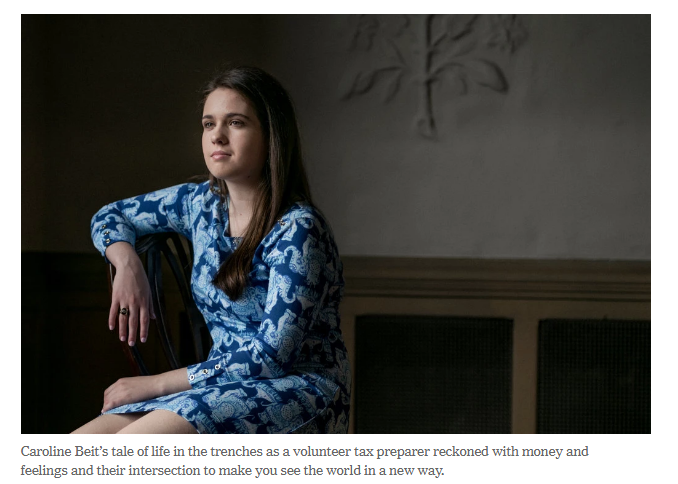
This essay was published by the New York times:

Click here for entire article

BRONXVILLE, N.Y.

“While I have not changed the tax system (though someday I plan to), I have changed how my clients interact with it.”

Caroline S. Beit

“Nothing can be said to be certain, except death and taxes.”

Not only do Benjamin Franklin’s words still resonate today, but, if you are like most, filing income taxes is simply unpleasant. For me, however, preparing taxes has been a telescopic lens with which to observe the disparate economic realities present in our society. In looking through this lens, I have seen firsthand how low wages and, at times, regressive public policy can adversely impact the financially fragile, and how I can make a difference.

This coming year will be my third volunteering every Saturday during tax season with AARP’s Tax-Aide Program. In the basement of the Morningside Heights Library in Manhattan, we help the elderly and low-income individuals file their taxes. During my first season, I handled organizational tasks and assisted intake counselors with the initial interview process.

When I told the AARP manager that I wanted to return the following season and do actual tax preparation, she was skeptical, especially since the next youngest tax preparer at my location was 37. That, however, did not deter me: Though I would be just 16 before the start of the season, I diligently studied the material and passed the advanced I.R.S. qualification test.

As a volunteer, my goal is to help my clients obtain every credit they are entitled to and place vitally needed money in their pockets. To do this, I need much more than just technical knowledge. It is also essential to connect on a human level. I make it a point to put each person at ease by actively listening to his or her story.

For example, the young woman, who is a recently minted United States citizen and barely speaks English, mentions that her disabled grandmother lives with her. Her story allows me to determine she can claim a dependent care credit for her grandmother and a $1,000 earned income credit. These credits represent approximately 20 percent of her income and will go toward buying her grandmother’s medications and other necessities.

I am saddened at times by the palpable stress of those living on the edge of economic subsistence. Basic necessities such as sneakers and dental care, which I had never thought twice about, are out of reach for many. I vividly remember the single mom from Queens who works at Target and spent $400 (a week’s paycheck) at H&R Block last year. By not having to pay for tax preparation this year and the credits she can claim, she confided she will be able to buy her son, who is my age, new shoes for track and hopefully see a dentist for a tooth that has been throbbing for months.

As a volunteer, I have learned the importance of empathizing, listening and communicating complex and technical matters simply. Making my clients feel at ease allows them to understand my explanation of how their money is being taxed. I have also gained insight into how tax policy affects the financial and physical health of the working poor and elderly. While I have not changed the tax system (though someday I plan to), I have changed how my clients interact with it.

Beyond Benjamin Franklin’s two certainties in life of death and taxes, I would add a third: the enduring power of the human spirit. I remember an octogenarian man with a cane who waited two hours in line on a bone-chillingly rainy Saturday in February. He is somehow able to survive in Manhattan on $15,000 of Social Security earnings a year. Even though his income is below the filing requirement, together we claim $77 of school tax and rent credits, which translates into two weeks of groceries.

When we finish, he says to me, “See you next year.” It is at that moment I know I have made a tangible difference.

Volunteer Time: New Hanover County VITA

14 May 18
Kim Manuel

No Comments

Happy 40th anniversary to New Hanover County VITA.  This is an awesome accomplishment to serve your taxpayers for 40 years.


On behalf of TaxSlayer, thank you for your volunteer service.


Volunteer Time: SPEC 4.0 watch us grow: Rural Maine

11 May 18
Kim Manuel
, ,
No Comments

Partner mentoring leads to rural success

As SPEC continues its efforts to help more taxpayers in rural communities, the RM & partner success stories are building too. The goal is to share as many of these stories as possible, with the premise that they may possibly help others expand their reach in rural areas.

Here’s a rural success story from Tax Consultant Therese (Tess) Armstrong

Describe to us your geographic area and current partnership base.

As the sole SPEC Relationship Manager in Maine, my territory covers the entire state – which is large enough to fit the five other New England states within its geographic borders.

How did your success story begin?

Back in 2008, Maine’s rural strategy plan included expansion into rural Aroostook County, and in partnership with AARP Tax-Aide, a VITA program was proposed at a presentation to local officials in Presque Isle.

What steps did you take next?

Three years after that initial presentation, United Way of Aroostook contacted me about establishing the Aroostook CA$H VITA coalition. Also, as initially proposed, program leaders were encouraged and agreed to volunteer with AARP Tax-Aide to obtain experience in tax preparation, site operation, and to learn the Quality Site Requirements necessary to run a successful VITA site.

How long did it take you to work this opportunity?

The saying, “never give up” is so true. It was five years from the time I initially presented my proposal to Stakeholders in Aroostook County and the actual establishment of their successful VITA program in 2013.

In your opinion, what were the key actions that made this turn out successfully?

Mentoring with AARP Tax-Aide of Maine provided Aroostook CA$H with an understanding of the complexities of operating a VITA site. Aroostook CA$H mentored with AARP Tax-Aide of Maine for one filing season. The next filing season the coalition successfully e-filed 151 federal tax returns, easily surpassing their initial set goal of 50 minimum tax returns. During the 2018 filing season, the coalition e-filed more than 700 federal tax returns.

Consistent leadership and enthusiastic support from United Way of Aroostook (and its board members) has also been integral toward the program’s success.

What advice would you give to fellow TCs/RMs to gain additional successes?

Positive reinforcement and quickly responding to your partner’s questions and concerns is instrumental in your partner’s continued engagement.

Other information:

The program has expanded to Fort Kent, Maine (on the Canadian Border) and Houlton Maine, but it took years to find the ideal sites in those locations. In 2017, County Federal Credit Union joined Aroostook CA$H and expanded the volunteer base to include 21 new Asset Building Coaches.

Volunteer Time: Tax-Aide site in Torrance, California

13 Apr 18
Kim Manuel

No Comments

We want to send a “Shout out” to a Tax-Aide site in Torrance, California that has decided to be open one day a month, post filing season, to help taxpayers with any questions, preparing their late TY2017 returns, amended returns, problem returns and prior year returns.

Thank you Terry B. for sharing this with us and the VITA/TCE community.  It takes a lot of commitment to extend their volunteer services.  We will be here to support you.